Modern businesses rely on more software than ever before.
Sales teams work from CRMs. Operations teams use project management platforms. Finance teams have their own systems. Customer data lives in one place, support tickets in another, and reporting dashboards pull information from somewhere else entirely.
Each tool solves a specific problem. The challenge begins when these tools need to work together.
For years, companies have relied on point to point integrations to connect their systems. It works well in the beginning. A direct connection is built between two platforms, data starts flowing, and the immediate problem is solved.
Then the business grows. A new platform is introduced. A team changes its process. An API update breaks an existing workflow. What was once a simple integration suddenly becomes a network of dependencies that requires constant maintenance.
Instead of creating dozens of direct integrations, organizations are moving towards connected architectures built around a shared integration layer. The Model Context Protocol is helping drive this shift by creating a more flexible way for systems to share information, support automation, and adapt as business needs change.
The goal is no longer just connecting software. It is creating systems that continue to work as the business evolves.
Point to point integrations vs connected systems
The difference between these two approaches becomes more obvious as organizations scale.
| Factor | Point to point integrations | Connected systems with MCP |
|---|---|---|
| Setup approach | Separate connection for every system | One shared integration layer |
| Maintenance | Increases as more tools are added | Easier to manage over time |
| Flexibility | Changes often require rework | Adapts more easily to new requirements |
| Data visibility | Information is spread across systems | Better visibility across workflows |
| Adding new tools | Requires additional integrations | Connects through the existing layer |
| Scalability | Becomes harder to maintain | Designed for long term growth |
| Cost over time | Often unpredictable | More efficient and sustainable |
The more systems a business uses, the greater the benefits of a connected approach.
Why traditional integrations break
Business systems are constantly changing. Software providers release updates. APIs evolve. Teams introduce new processes. Departments adopt new tools. Every change creates risk when systems rely on tightly connected integrations.
Consider a hospitality business that uses separate platforms for reservations, guest communication, payments, and reporting. If every system is directly connected to every other system, a single change can disrupt multiple workflows at once. The same challenge exists in recruitment, real estate, and many other industries.
Teams spend valuable time fixing integrations instead of improving operations. This is why businesses are looking beyond traditional B2B integration software and exploring more flexible approaches.
What connected systems look like
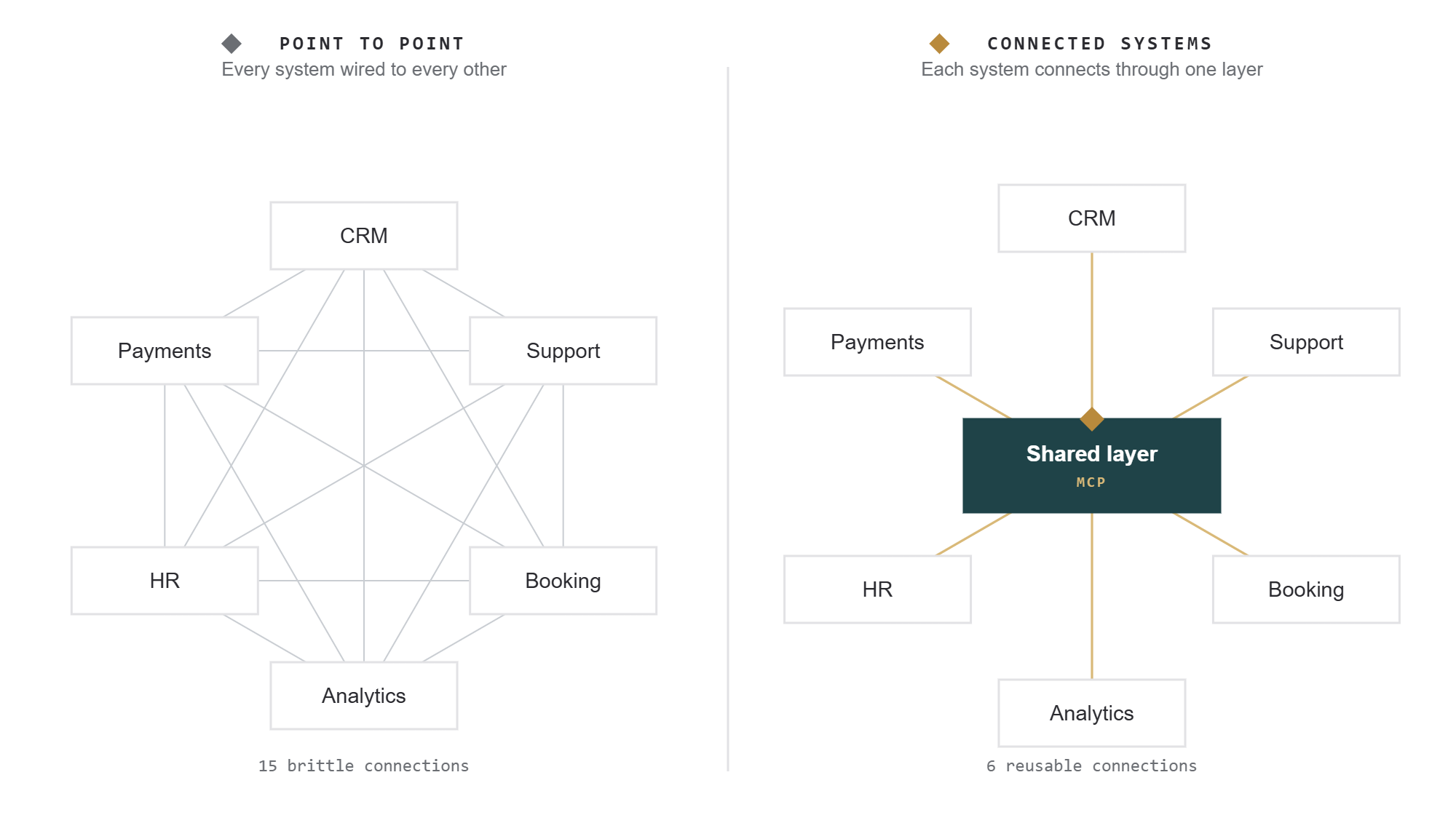
Connected systems replace multiple direct integrations with a shared integration layer. Instead of building a separate connection every time a new application is introduced, each system connects through a common framework. The flow is much simpler.
Everything routes through one layer
- CRM→Shared integration layer→Customer support platform
- Booking system→Shared integration layer→Guest communication platform
- Recruitment platform→Shared integration layer→HR system
- Analytics dashboard→Shared integration layer→Business applications
This approach creates a more reliable foundation for growth. When a new tool is introduced, it connects to the shared layer instead of requiring multiple new integrations. That means less maintenance, fewer disruptions, and faster implementation.
What the Model Context Protocol changes
The Model Context Protocol creates a common way for systems to exchange information. Instead of building custom integrations for every workflow, businesses can create reusable connections that provide access to live information across multiple applications.
In simple terms, MCP for business systems reduces complexity. Rather than maintaining dozens of separate integrations, organizations can create a consistent framework for how data moves between tools.
What this makes easier
- Access current information across systems
- Maintain data consistency
- Introduce new applications quickly
- Reduce integration maintenance
- Improve visibility across workflows
- Support future growth
The value of the Model Context Protocol goes beyond technical simplicity. It gives businesses the flexibility to adapt without constantly rebuilding their infrastructure.
Why this matters for AI workflow automation
Automation only works when it has access to reliable information. When data is spread across disconnected systems, workflows become slower, less accurate, and harder to maintain. Connected systems solve this problem by ensuring information flows consistently between platforms.
- Data scattered across tools
- Workflows slow and error prone
- Manual updates between platforms
- Automation creates more work
- Real time access to live data
- Hospitality teams see reservations and guest preferences
- Recruitment teams review candidates and feedback in one flow
- Real estate links listings, customers and operations
The quality of AI workflow automation depends on the quality of the underlying connections. Without connected systems, automation creates more work. With the right foundation, automation becomes easier to manage and easier to scale.
Why businesses are rethinking B2B integration software
Traditional B2B integration software was designed for a different era. Today, businesses need more than simple data transfers between applications. They need systems that can adapt quickly, support changing workflows, and provide access to information in real time.
What modern integration strategies focus on
- Reusable connections
- Live access to business data
- Flexible workflows
- Centralized visibility
- Faster implementation
- Long term scalability
Integration is no longer just a technical requirement. It is a business capability. Organizations that can connect systems quickly can move faster, respond to change more effectively, and improve the way teams work together.
Explore our servicesBuilding for growth instead of maintenance
Many businesses underestimate the hidden cost of disconnected systems. Development teams spend time fixing broken integrations. Operations teams work around missing information. Employees manually update records across multiple platforms. These small inefficiencies add up over time.
Connected systems reduce this burden by creating a foundation that supports change. Instead of rebuilding workflows every time a new platform is introduced, businesses can extend existing connections and maintain consistency across systems. The focus shifts from maintenance to improvement.
How connected systems support real operations
Connected architectures are already helping businesses across multiple industries. In hospitality, they bring together guest communication, booking platforms, and operational workflows. In recruitment, integrated workflows support faster candidate evaluation and better visibility across hiring pipelines. In real estate, connected systems link listings, customer information, and internal operations.
When information flows smoothly between systems, teams spend less time managing data and more time delivering value.
The future belongs to connected systems
Technology will continue to evolve. Businesses will adopt new tools. Existing platforms will change. Customer expectations will grow. Organizations that rely on brittle point to point integrations may struggle to keep pace.
Those that invest in connected systems built around a shared integration layer will be better prepared for change. The Model Context Protocol provides a practical way to build these connections, not by adding more integrations, but by creating systems that work together without constant rebuilding.
Because the businesses that move fastest are not the ones with the most software. They are the ones whose systems work together.
Request a walkthroughFrequently asked questions
What is the Model Context Protocol?
The Model Context Protocol is a framework that helps systems share information through a consistent approach. It reduces the need for custom integrations and makes it easier to connect tools across the business.
Why do point to point integrations become difficult to maintain?
Every new system requires another direct connection. As the number of tools increases, maintaining those connections becomes more time consuming and expensive.
How does MCP for business systems improve scalability?
Instead of creating new integrations every time a tool is added, businesses connect systems through a shared integration layer. This makes it easier to grow without rebuilding existing workflows.
How does connected architecture support AI workflow automation?
Automation depends on access to reliable information. Connected systems ensure workflows can access current data across multiple platforms, reducing manual work and improving efficiency.
Is B2B integration software still important?
Yes. However, businesses are increasingly looking for solutions that support reusable connections, centralized management, and real time data access instead of relying solely on traditional point to point integrations.