A guest visits your website looking for a room for the weekend. Before they reach out, they have probably already compared a handful of properties, checked rates across different platforms, and narrowed their options to a few hotels.
At that moment, speed matters. If they send an inquiry about availability, they expect an answer quickly. Not later in the day. Not after a reservation agent has checked three different systems. They want accurate information while they are still considering their options.
This expectation is not limited to guests. Travel agents, corporate booking partners, and event organizers all work within tight timelines. The faster a hotel can provide reliable information, the greater its chances of securing the booking.
The challenge is that hotel availability is constantly changing. Rooms are booked, cancelled, upgraded, and released throughout the day. Rates fluctuate based on demand. Inventory shifts across multiple channels. For many hospitality businesses, the issue is not a lack of technology. It is the fact that valuable information often lives across multiple systems, making simple tasks more complicated than they need to be.
When availability becomes an operational challenge
Ask any reservations team what slows them down, and the answer is rarely a lack of effort. More often, it is the process.
A guest asks about room availability. A travel partner requests rates for a group booking. A corporate client wants confirmation before moving forward with an event. Before responding, someone needs to verify inventory, confirm rates, check restrictions, and ensure the information is still current.
Individually, these tasks may only take a few minutes. Across dozens of inquiries each day, they add up quickly.
Many hotels already use a hotel management system to manage reservations and operational data. Yet teams often find themselves moving between platforms to piece together the information needed for a single response. The result is a workflow that depends heavily on manual effort. As inquiry volumes increase, these small inefficiencies become much harder to ignore.
The cost of slow responses
A delayed response does more than create extra work for staff. It can directly affect revenue.
Most guests do not wait around for answers. If one property responds quickly while another takes hours, the faster response often wins. The same applies to travel agents and corporate booking partners. They need reliable information to make decisions. Delays create uncertainty, and uncertainty can lead to lost business.
There is also a guest experience factor that is easy to overlook. The booking journey begins long before a guest arrives at the property. Every interaction shapes their perception of the hotel. Quick, accurate communication signals professionalism and builds trust. Slow responses can create frustration before the booking is even confirmed.
How response speed impacts hotel operations
| Booking process area | Manual workflow | Connected hotel automation |
|---|---|---|
| Availability checks | Staff check multiple systems manually | Live availability is accessible instantly |
| Guest inquiries | Delayed responses due to manual verification | Faster responses using real-time data |
| Travel partner requests | Requires back-and-forth communication | Accurate information available immediately |
| Rate verification | Time spent validating rates across platforms | Rates synced with connected systems |
| Reservation team workload | High administrative effort | Reduced repetitive tasks |
| Direct booking experience | Slower guest journey | Faster, smoother booking process |
| Booking conversion potential | Higher risk of losing inquiries | Better chance of securing bookings quickly |
These operational differences highlight an important reality. The challenge for most hotels is not the lack of technology, but how effectively their existing systems work together.
Why more software is not always the answer
Hotels have invested heavily in technology over the years. Most properties already use hotel booking software, property management platforms, and hospitality management software to support daily operations.
Yet many teams still face the same challenge: information exists, but accessing it takes too much time. Adding another standalone tool rarely solves the problem. What hotels need is better connectivity between the systems they already use.
When operational data remains isolated, staff spend valuable time switching between applications, copying information, and manually updating records.
The goal should not be to add complexity. It should be to remove it.
The hospitality businesses making the greatest progress today are not necessarily those with the most software. They are the ones creating connected workflows that make information easier to access and act on.
What hospitality teams actually need
Technology should help teams respond faster, not create more steps. That starts with visibility.
Reservation teams need access to current availability without jumping between systems. Booking partners need accurate information without waiting for manual confirmation. Guests need answers while they are still ready to book.
Beyond availability, hotels also need stronger control over their direct booking channels. Many independent hotel groups continue to depend heavily on third party platforms to generate bookings. While those channels play an important role, they also come with commission costs and limited ownership of the guest relationship.
Creating a better direct booking experience requires more than marketing efforts. It requires operational systems that can support fast, accurate, and consistent communication. When booking information is accessible in real time, hospitality teams can focus less on administration and more on creating exceptional guest experiences.
How Zirora Direct helps hotels respond faster
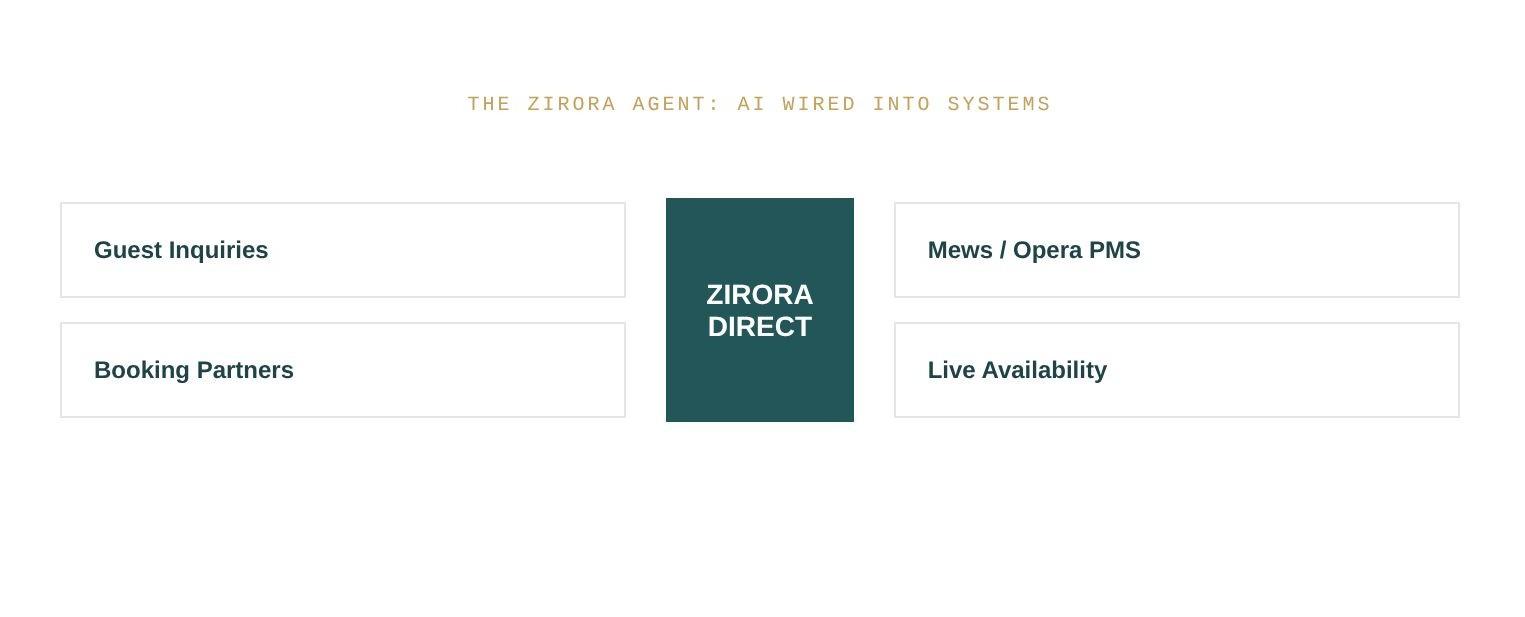
This is exactly the challenge Zirora Direct was built to address. Zirora Direct is a hotel partner booking platform designed to help hospitality businesses strengthen direct booking channels while simplifying the way booking information moves across their operations.
By connecting with existing systems, including leading PMS platforms such as Mews, Opera, and Cloudbeds, Zirora Direct gives hospitality teams access to live booking information when they need it most. Instead of manually checking multiple platforms, teams can work with accurate availability data that reflects what is happening across the property in real time.
Benefits across the booking journey
- Guests receive faster responses
- Travel partners gain better visibility into available inventory
- Reservation teams spend less time on repetitive administrative tasks
- Hotels gain greater control over bookings and guest relationships
Most importantly, teams can act on information immediately rather than spending valuable time searching for it.
Request a walkthroughBetter information creates better guest experiences
Hospitality has always been about service. The difference today is that service begins much earlier than it once did.
Guests form opinions about a property from the very first interaction. A fast response, accurate information, and a seamless booking experience can have just as much influence as the stay itself. When hotel automation is built around connected systems, those experiences become easier to deliver consistently.
Teams can respond with confidence because they are working with current information. Guests receive answers faster. Booking partners can make decisions without unnecessary delays. The technology itself fades into the background, allowing hospitality professionals to focus on what they do best.
Conclusion
Hotel operations generate a constant flow of information. Availability changes by the minute, guest expectations continue to rise, and booking decisions happen faster than ever before. The challenge for many hospitality businesses is not collecting data. It is making that data useful at the moment it is needed.
Connected hotel automation helps bridge that gap. By bringing together hotel management software, hotel booking management software, and live operational data, hospitality teams can respond faster, reduce manual effort, and create a better booking experience for guests and partners alike.
The ability to read live availability and act on it is becoming a standard expectation for modern hospitality.