Talk to any property manager and you’ll hear a familiar story. The day rarely goes as planned.
A new enquiry comes in for a vacant unit. A tenant reports a maintenance issue. A landlord wants an update on occupancy. A viewing needs to be scheduled. Another prospect is waiting for a follow up. Before lunch, there are already dozens of conversations and tasks competing for attention.
The challenge isn’t a lack of effort. It’s that many property teams are trying to manage all of this across disconnected systems. Listings sit in one platform, lead information in another, tenant communication happens through email and SMS, and reporting often requires data from multiple sources. As portfolios grow, these small inefficiencies become major operational bottlenecks.
The real cost of disconnected property operations
Most property businesses already have software. The problem is that the software often doesn’t work together.
A lead generated from Zillow may need to be entered manually into a CRM. A viewing appointment requires updates across multiple systems. Maintenance requests need separate tracking. Owner reports require information from several platforms.
None of these tasks are difficult. They’re simply repetitive.
Common challenges property teams face
| Challenge | Business impact |
|---|---|
| Manual lead qualification | Slower response times |
| Disconnected systems | Duplicate work |
| Missed follow ups | Lost leasing opportunities |
| Manual reporting | Reduced productivity |
| Poor operational visibility | Slower decision making |
When these issues happen repeatedly, they consume valuable time that could be spent supporting tenants, owners, and prospective renters.
Every vacant day has a cost
An empty property doesn’t just mean lost rental income. It creates additional pressure across the business.
Leasing teams need more enquiries. Property managers need to provide updates. Owners expect answers. Prospective tenants want quick responses. The longer a property remains vacant, the more work is required to fill it.
That’s why speed matters.
What delays often lead to
- Lost rental revenue
- Missed leasing opportunities
- Lower tenant satisfaction
- Increased administrative workload
- Reduced operational efficiency
In competitive markets, even a delayed follow up can mean losing a qualified tenant to another property.
Why traditional workflows struggle to scale
Most property businesses didn’t intentionally create disconnected processes. Over time, different tools were added to solve different problems.
- Listing platforms for marketing properties
- CRM systems for lead management
- Maintenance tools for service requests
- Email and SMS for communication
- Spreadsheets for reporting
Each tool serves a purpose. The challenge begins when none of them communicate effectively. As portfolios grow, people become responsible for connecting everything manually.
That approach works for a small portfolio. It becomes increasingly difficult as operations expand.
What high-performing property teams do differently
The most efficient property teams aren’t necessarily the largest. They’re the teams that have removed friction from their daily operations.
- Leads entered manually
- Follow ups tracked in spreadsheets
- Maintenance updates shared through email
- Reporting requires data gathering from multiple systems
- Teams spend hours on administrative tasks
- Leads captured automatically
- Follow ups happen on time
- Maintenance requests are routed immediately
- Reporting becomes easier and faster
- Teams focus on higher value work
The goal isn’t to automate relationships. The goal is to automate the repetitive tasks that get in the way of those relationships.
A smarter approach to property management automation
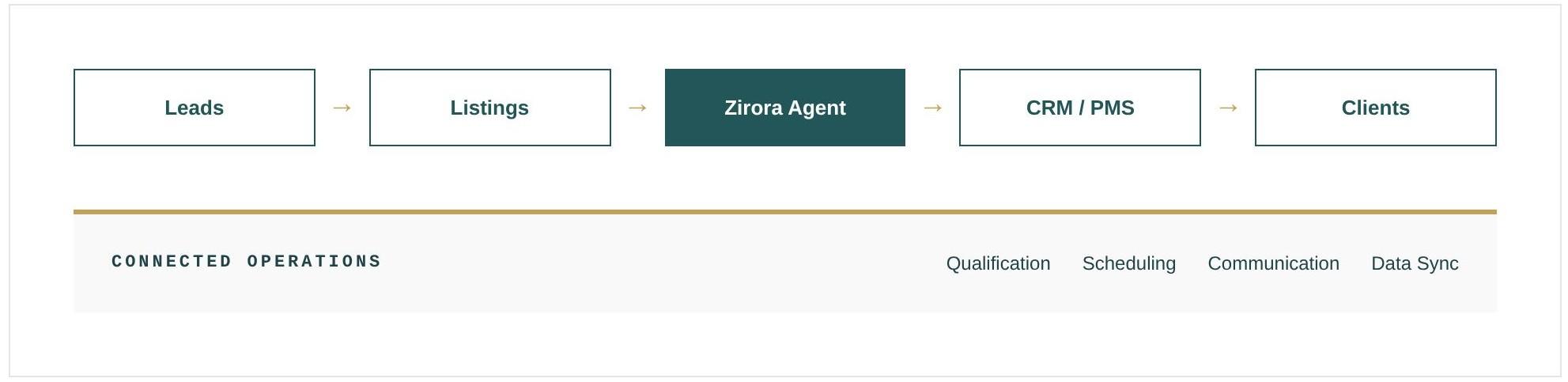
Property businesses generate enormous amounts of information every day. Enquiries, maintenance requests, lease renewals, owner communications, and tenant interactions all create operational data.
The challenge is turning that information into action. Modern property management automation helps reduce manual effort by creating connected workflows across the business.
A typical leasing workflow
- A prospect submits an enquiry.
- Lead information is captured.
- A viewing is scheduled.
- Follow up communication is initiated.
- The application is reviewed.
- The lease process moves forward.
- Renewal activities are monitored proactively.
When these activities are coordinated effectively, teams spend less time managing processes and more time serving clients.
Why we built Zirora Leasing Agent
Over the years, we noticed a common challenge across property businesses. The issue wasn’t a lack of demand. The issue wasn’t a lack of expertise. The issue was that talented teams were spending too much of their day on administrative work.
They were updating records, coordinating communications, tracking tasks, and moving information between platforms that weren’t designed to work together.
That’s why we built Zirora Leasing Agent. Rather than creating another system to manage, Zirora Leasing Agent helps connect the systems property teams already use. By bringing together Zillow, AppFolio, calendars, email, SMS, CRM systems, and operational workflows, property teams gain a more connected way of working.
How Zirora Leasing Agent helps
- Lead qualification and routing
- Prospect follow ups
- Viewing coordination
- Tenant communication support
- Lease renewal visibility
- Connected operational workflows
The result is a more responsive operation that helps property teams move deals forward while spending less time on repetitive administrative tasks.
Request a walkthroughWhy property teams are investing in automation
Property businesses are under pressure to do more with the resources they already have. Connected operations help teams work more efficiently while maintaining a high level of service.
| Business goal | Expected benefit |
|---|---|
| Reduce vacancy periods | Faster leasing cycles |
| Improve tenant communication | Better tenant experience |
| Increase team productivity | Less administrative work |
| Improve reporting | Better visibility |
| Support portfolio growth | Greater scalability |
The objective is not to replace people. The objective is to give people more time to focus on work that creates value.
Conclusion
Property professionals didn’t enter the industry to spend their days updating spreadsheets or moving information between systems. They entered it to help people, solve problems, and keep properties performing at their best.
As portfolios grow, operational complexity grows with them. The businesses that continue to thrive will be the ones that simplify that complexity.
With connected workflows, modern leasing management software, and solutions like Zirora Leasing Agent, property teams can spend less time managing processes and more time building relationships, supporting owners, and keeping properties occupied.
Because moving deals forward should be about people, not paperwork.
Frequently asked questions
What is property management automation?
Property management automation helps reduce repetitive administrative work by streamlining tasks such as lead management, tenant communication, maintenance coordination, lease tracking, and reporting.
How does rental property management software help property businesses?
Rental property management software provides a central place to manage tenants, leases, maintenance requests, communications, and operational information while reducing manual work.
What is real estate automation software?
Real estate automation software helps automate routine activities such as lead qualification, follow ups, scheduling, notifications, and workflow management.
How does Zirora Leasing Agent support property teams?
Zirora Leasing Agent helps connect listing platforms, CRM systems, communication channels, calendars, and operational workflows to support leasing activities and improve operational visibility.
Why is leasing management software important for growing portfolios?
As portfolios expand, leasing management software helps teams stay organized, respond faster, manage enquiries efficiently, and maintain visibility across the leasing lifecycle.