Hiring people has always been about finding the right fit. What has changed is how fast companies need to do it.
As businesses grow, hiring becomes harder to manage. Recruiters deal with more applications, more channels to source from, more coordination with hiring managers, and rising expectations for a smooth candidate experience. At the same time, leadership expects hiring to move faster without lowering standards.
In many companies, the hiring process has not kept up with this pace. Resumes are still checked one by one. Candidate details are spread across different systems. Recruiters end up spending too much time on repetitive tasks instead of focusing on real conversations with candidates.
This is why more teams are starting to look at AI recruitment software. Not because they want to replace recruiters, but because they want to remove the slow and manual parts of hiring.
Help recruiters spend more time with people and less time on routine work.
Why hiring gets harder as companies grow
Hiring a few people occasionally is very different from hiring at scale.
When application numbers increase, even small delays start to create bigger problems. What once felt manageable quickly becomes overwhelming when every open role attracts hundreds of applications.
Recruitment teams often run into challenges like:
- Too many applications coming in at once
- Long hours spent reading resumes
- Different recruiters using different ways to evaluate candidates
- Delays in shortlisting people
- Repeating the same updates across tools
- Not having a clear view of the hiring pipeline
Most of the time, the problem is not finding candidates. It is finding time to properly review them.
Why keywords are not enough anymore
Many older tools depend too much on keyword matching. The issue is simple. Real people do not always describe their work using the same words as a job description.
A strong candidate may have the right experience and skills but express them differently. In a keyword based system, that person can easily be missed.
This is why companies are moving towards better ways of doing AI candidate screening and AI resume screening. Instead of only looking for exact words, modern systems look at:
- Skills and experience in context
- Career growth and achievements
- Relevance of past roles
- Overall match with the job requirement
Hiring is not about matching words. It is about understanding people.
Traditional screening vs AI candidate screening
| Screening area | Traditional resume screening | AI candidate screening |
|---|---|---|
| Candidate review | Manual review of every application | Prioritized candidate recommendations |
| Evaluation method | Keyword matching and manual assessment | Context-based analysis of skills and experience |
| Screening speed | Time-consuming for high-volume hiring | Faster initial candidate evaluation |
| Consistency | Can vary between recruiters | Structured and standardized screening criteria |
| Recruiter workload | Significant administrative effort | Reduced repetitive screening tasks |
| Candidate visibility | Strong candidates may be overlooked | Broader evaluation beyond exact keywords |
| Hiring scalability | Difficult to manage at scale | Supports growing recruitment needs |
What hiring teams actually need
Most recruiters are not asking for more tools. They are asking for less confusion. A good hiring process should feel connected from start to finish.
That means:
- Writing job descriptions
- Job details should be clear and aligned between hiring managers and recruiters so there is no back and forth later.
- Sharing jobs across channels
- Roles should be easy to publish across job boards, career pages, and other platforms without repeating the same work.
- Finding candidates
- Recruiters need better visibility into talent sources so they can spend more time engaging instead of searching manually.
- Evaluating candidates
- There should be a consistent way to review applicants so decisions are fair and easier to compare.
- Tracking progress
- Hiring teams should always know where candidates are in the process without digging through different systems.
When these parts are not connected, recruiters end up spending more time managing work than doing actual hiring.
How Zirora Sourcing Agent supports hiring teams
Many companies are now moving towards recruitment automation tools that reduce manual effort and improve clarity. Zirora Sourcing Agent is built with that idea in mind.
Instead of being just another tool in the system, it supports the full early stage hiring process while keeping recruiters in control. It helps teams:
- Turn hiring needs into clear job descriptions
- Create structured screening guidelines
- Share job posts across multiple channels
- Find relevant candidates faster
- Review resumes against job requirements
- Assess profiles in a more structured way
- Support guided screening conversations
- Keep hiring data consistent across systems
The important part is that recruiters still make the final decision. The system is there to reduce repetitive work, not to take over judgment.
Request a walkthroughWhy human judgment still matters
Even with better tools, hiring is still a people decision.
Recruiters understand things that no system can fully measure. Things like communication style, motivation, cultural fit, and long term potential. A resume only tells part of the story.
That is why human involvement is still essential. The best results come when technology handles structure and recruiters handle judgment. One supports the other.
The real impact of smarter hiring systems
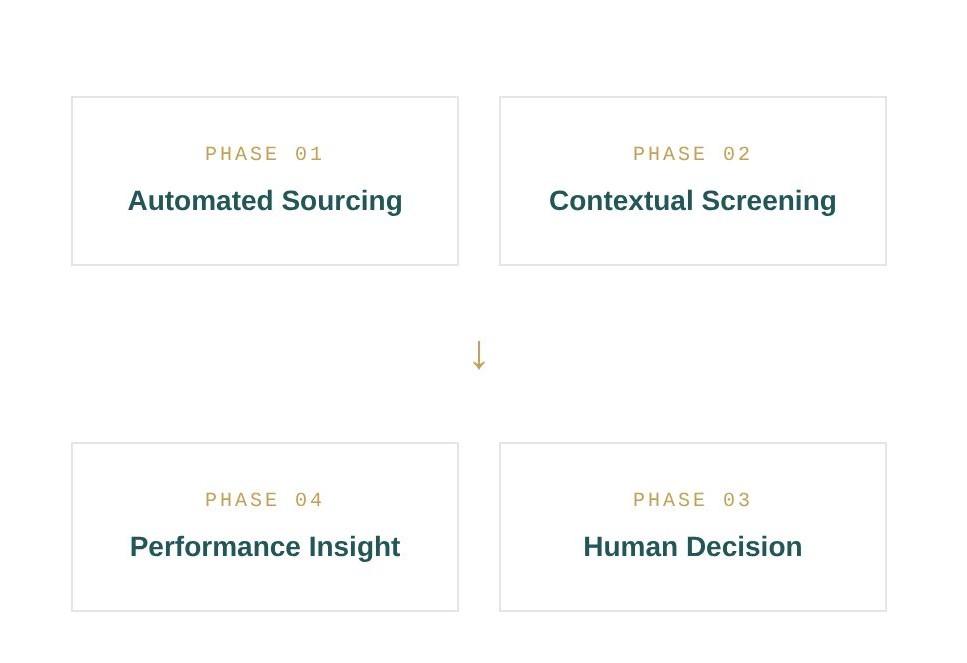
Companies that improve their hiring process usually notice clear changes such as:
- Faster shortlisting of candidates
- Less time spent on repetitive tasks
- More consistent evaluation of applicants
- Better communication between teams
- Clearer visibility of hiring progress
- Easier scaling of recruitment efforts
Instead of hiring more people just to handle workload, companies can help their existing teams work more efficiently. This is why more organizations are adopting recruitment automation tools.
Building a hiring process that can scale
Hiring is not just about filling roles. It is about building a system that can support growth.
As companies expand, manual hiring processes start to slow things down. Teams that continue working this way often struggle to keep up.
Companies that move towards connected systems and better structured workflows are able to respond faster and hire more effectively. Tools that support AI recruitment software style workflows help remove delays and improve consistency without removing human control.
Conclusion
Most hiring problems are not caused by lack of candidates. They come from slow and disconnected processes. Manual resume screening, scattered systems, and repetitive tasks make hiring more complicated than it needs to be.
Modern recruitment systems help simplify this process by improving how candidates are sourced, reviewed, and shortlisted, while still keeping recruiters in charge. Zirora Sourcing Agent is one example of how recruitment automation tools can support teams by reducing manual work and improving clarity across the hiring process.
When hiring becomes more structured and less manual, companies move faster, make better decisions, and focus on what matters most: people.
Frequently asked questions
What is AI recruitment software?
AI recruitment software helps automate parts of the hiring process, including candidate sourcing, resume screening, and workflow management. It enables recruiters to reduce manual tasks and focus more on candidate engagement and decision-making.
How does AI candidate screening work?
AI candidate screening evaluates applications based on skills, experience, qualifications, and job requirements. It helps recruiters identify relevant candidates more efficiently while maintaining a structured review process.
What is an automated resume screening system?
An automated resume screening system reviews and organizes resumes according to predefined criteria, helping recruitment teams prioritize qualified candidates and manage high application volumes more effectively.
What are the benefits of recruitment automation tools?
Recruitment automation tools can improve hiring efficiency by reducing repetitive tasks, speeding up candidate shortlisting, improving process consistency, and providing better visibility into the recruitment pipeline.
Can AI recruitment software replace recruiters?
No. AI recruitment software is designed to support recruiters, not replace them. While it can automate administrative and screening tasks, recruiters remain responsible for evaluating candidate suitability, conducting interviews, and making final hiring decisions.