Businesses today rely on more software than ever before.
Sales teams use customer relationship platforms. Operations teams depend on project management tools. Support teams work inside ticketing systems. Finance teams manage data through accounting software.
Each platform serves a specific purpose. The challenge begins when these systems need to work together.
For years, organizations have relied on custom integrations, manual data transfers, and complex workflows to connect their technology stack. While these approaches may solve immediate problems, they often become difficult to maintain as businesses grow.
This is where the Model Context Protocol is starting to change the conversation. Instead of building separate connections for every tool and workflow, it introduces a more consistent way for systems to share information and work together.
But what does that actually mean for businesses, and where does it make sense to use it? Let's break it down in plain English.
The integration problem businesses face today
Most organizations do not struggle because they lack technology. They struggle because their technology does not communicate effectively. Customer information may live in one platform while operational data sits somewhere else, and teams often switch between multiple applications to complete a single task.
Many businesses rely on direct connections between systems, often called point to point integrations. At first, these seem straightforward. Need to connect a CRM with a support platform? Create an integration. Need to sync data between a booking system and a reporting dashboard? Build another connection.
The problem is that every new application adds another layer of complexity. Over time, businesses end up managing dozens or even hundreds of separate integrations. When one system changes, multiple workflows can break, creating hidden costs in the form of maintenance, troubleshooting, and manual work.
Why connected systems matter
Modern businesses need more than isolated applications. They need connected systems that allow information to flow naturally across departments and workflows. Connected systems create a shared environment where data can move securely and consistently between platforms.
What that makes possible
- Better visibility across operations
- Reduced manual work
- Faster decision making
- Improved data consistency
- Easier adoption of new tools
- More reliable automation
The value does not come from adding more software. It comes from helping existing systems work together more effectively.
What is the Model Context Protocol?
The Model Context Protocol is a framework that creates a standardized way for models, applications, and business systems to exchange information. In simple terms, it helps different systems communicate through a common approach instead of relying on custom integrations for every use case.
Think of it as a shared language. Without one, every system needs a separate translator. With one, systems communicate far more efficiently.
Rather than creating unique integrations between every application, organizations can establish reusable connections that support multiple workflows. This makes it easier to access live information and maintain consistency across the business.
How MCP for business systems works
Traditional integrations often follow a one to one approach. System A connects directly to System B. System B connects to System C. System C connects to System D. As the number of systems increases, so does the complexity.
MCP for business systems takes a different approach. Instead of creating separate connections between every platform, organizations create a shared integration layer, and the flow becomes much simpler.
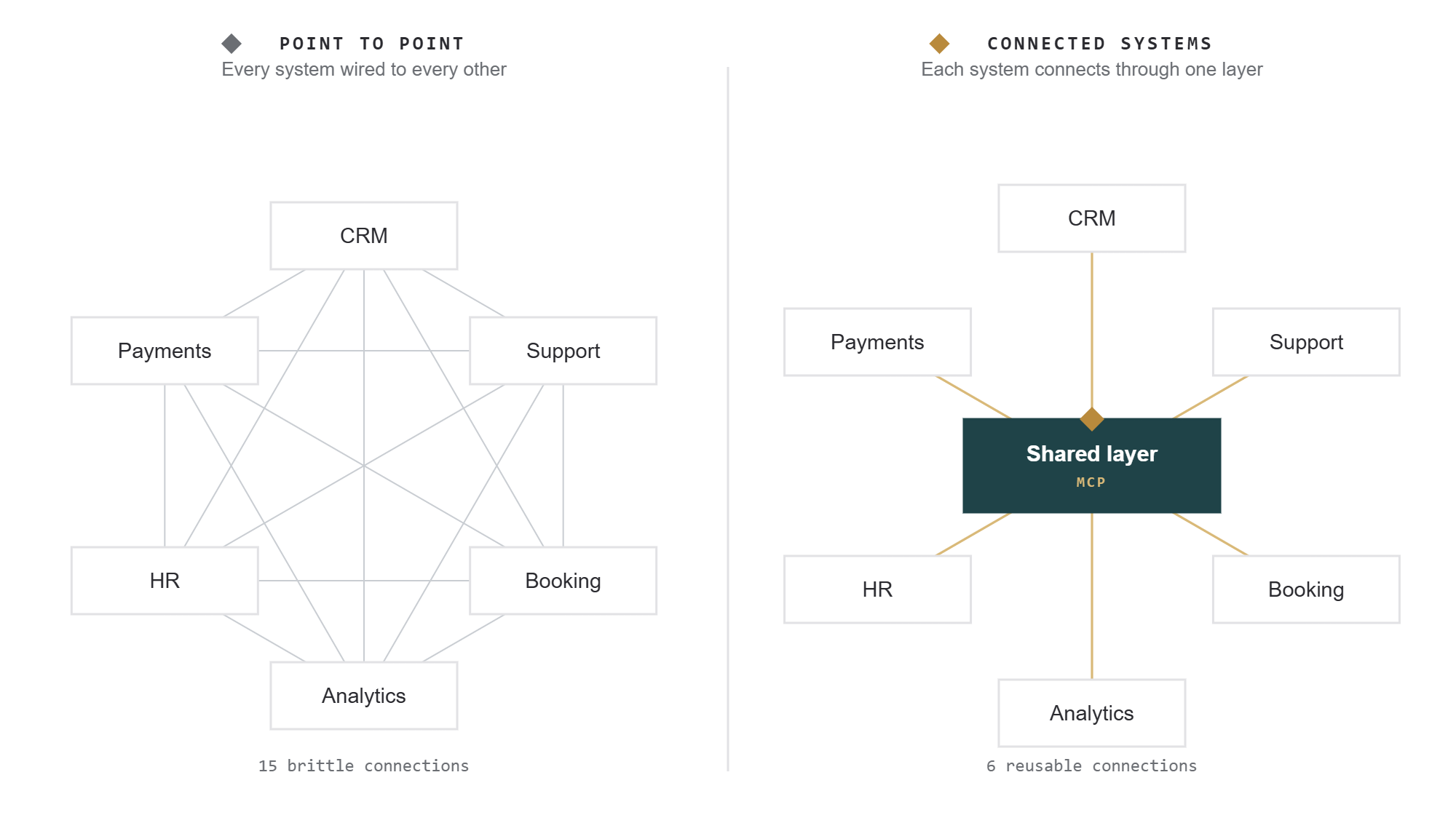
Everything routes through one layer
- CRM→Shared integration layer→Support platform
- Booking system→Shared integration layer→Guest communication platform
- Recruitment platform→Shared integration layer→HR system
- Analytics dashboard→Shared integration layer→Business applications
This structure reduces maintenance and makes it easier to introduce new tools without rebuilding existing workflows.
Traditional integrations vs MCP integration
The difference becomes more noticeable as businesses scale.
| Factor | Traditional integrations | MCP integration |
|---|---|---|
| Connection model | Separate connection for each system | Shared integration framework |
| Maintenance effort | Increases as systems grow | Easier to manage over time |
| Scalability | Difficult to expand | Built for long term growth |
| Data access | Often fragmented | Consistent across platforms |
| Flexibility | Requires custom work for changes | Adapts more easily |
| Visibility | Limited across workflows | Improved operational visibility |
| Adding new tools | Requires additional integrations | Connects through the existing framework |
What the Model Context Protocol actually changes
The biggest change is not technical. It is operational. The Model Context Protocol shifts the focus away from managing integrations and toward improving business workflows.
Instead of asking "How do we connect these systems?" organizations can start asking "How do we improve the way teams work?" That shift creates several benefits.
Faster implementation
Teams spend less time building and maintaining custom integrations.
Better access to information
Workflows can access current information across multiple systems.
Greater flexibility
Businesses can introduce new tools without disrupting existing processes.
Reduced maintenance
Reusable connections reduce the need for constant updates.
Stronger collaboration
Teams work with consistent information across departments. The result is a more connected and adaptable business environment.
Why AI system integration depends on connected data
Automation works best when it has access to accurate information. Disconnected systems create gaps. When data is outdated or spread across multiple applications, workflows become less effective. This is why AI system integration depends on connected data.
- Information outdated or duplicated
- Workflows stall waiting on manual updates
- Teams manage data instead of acting on it
- Automation quality is capped by the gaps
- Hospitality: bookings, guest preferences and ops in one flow
- Recruitment: live data from applicant tracking and hiring
- Real estate: listings, customer data and operations linked
- Automation scales on a reliable foundation
The quality of automation depends on the quality of the connections behind it. Without connected systems, teams spend more time managing data than creating value.
Where the Model Context Protocol works best
The Model Context Protocol delivers the greatest value when businesses rely on multiple systems that need to share information. Common use cases include:
- Hospitality operations
- Recruitment workflows
- Customer support
- Sales and marketing operations
- Real estate management
- Internal business operations
Any environment with multiple applications and frequent data sharing can benefit from a more connected approach.
Explore our servicesWhere MCP does not belong
Not every challenge requires the Model Context Protocol. Simple workflows with limited integration needs may not benefit from additional complexity. For example, MCP may not be necessary for:
- Standalone internal tools
- Small one time automations
- Basic reporting workflows
- Single platform processes
The goal should never be to adopt a new framework simply because it exists. The goal should be to solve a real business problem, and organizations should choose the approach that best fits their operational needs.
Building for change instead of rebuilding for change
Business systems will continue to evolve. New platforms will emerge, existing tools will change, and customer expectations will grow. Organizations that rely heavily on custom integrations may struggle to adapt, while those that invest in connected systems create a foundation that supports long term growth.
The value of the Model Context Protocol is not the protocol itself. The value lies in creating a more flexible and sustainable way for systems to work together.
Because the businesses that move fastest are not the ones with the most software. They are the ones whose systems communicate effectively.
Request a walkthroughFrequently asked questions
What is the Model Context Protocol?
The Model Context Protocol is a framework that provides a consistent way for models, applications, and business systems to exchange information.
How does MCP for business systems improve integration?
It creates a shared integration framework that reduces the need for custom connections between every system.
Is MCP integration replacing APIs?
No. APIs remain essential. MCP works alongside existing APIs by creating a more consistent way to access and manage information across systems.
Why are connected systems important?
Connected systems improve data visibility, reduce manual work, and help businesses adapt more easily as their technology stack evolves.
When should businesses use the Model Context Protocol?
Organizations should consider MCP when they rely on multiple systems that need to share information across workflows and departments.