Hotels lose margin every time a booking routes through an OTA, wholesaler, or GDS. Commission structures erode revenue, pricing control sits with the intermediary, and the hotel has no direct relationship with the agent placing the booking. For a group operating 35 properties across four countries, that leakage compounds into a strategic problem.
Zirora built Zirora Direct, a B2B Partner Portal that eliminates the middleman. Travel agencies and corporate clients book directly into the hotel's core systems, in real time, through a purpose-built interface with an embedded AI assistant that follows the same protocol patterns emerging in agent-to-agent commerce.
The result: retained margins, stronger agent relationships, and a platform already positioned for the next generation of AI-driven purchasing.
The client
A hotel group with 35 operating hotels and 8,000+ guest rooms across four countries, with an active expansion pipeline reaching into a fifth. At that scale, fragmented tooling is not an inconvenience, it is an operational cost centre. Every phone call, email thread, and manual rate check that a five-property group absorbs becomes a systemic drag when multiplied across dozens of properties and hundreds of agent relationships.
The problem
The client faced five interconnected challenges:
- No direct B2B booking channel. Agents accessed inventory through third-party aggregators, so the hotel had no control over the booking experience and no direct data on who was booking, or why.
- Dependency on external distributors imposed a ceiling on margin performance: every intermediary took a cut.
- Rate parity was resource-intensive. With bookings flowing through multiple channels, maintaining consistent pricing and preventing parity violations consumed staff time.
- Agent relationships were shallow. When the primary interface is a neutral platform shared across hundreds of suppliers, loyalty follows the platform, not the hotel.
- Commission leakage from a meaningful share of booking volume directly reduced revenue.
These objectives reinforce each other: a portal agents find useful drives adoption, adoption drives volume, and volume through a direct channel converts to margin.
The solution: a direct booking portal with an embedded AI assistant
Zirora designed the platform end-to-end: architecture, Oracle PMS integration, interface design, and deployment. Zirora Direct gives agencies and corporate clients a self-service environment for searching, booking, and managing reservations across the entire portfolio.
The sections below cover the main components, the direct booking portal, the AI assistant, live integration with Oracle PMS, and interface design, then the business impact and what it means for prospective clients.
A direct booking portal
The portal gives agencies and corporate clients a self-service environment for searching, booking, and managing reservations across the entire portfolio.
- Access and roles. Role-based login for agency and corporate users, with multiple users per account. An internal admin panel lets hotel staff manage accounts and access without IT involvement.
- Hotel search and availability. Real-time, multi-property search with live rates and booking policies. Agents never need to call or email a reservations team; data surfaces from the same source of truth the hotel operates on.
- Booking and confirmation. Bookings write directly into the property management system; instant confirmation returns to the agent. No email chains, no manual processing.
- Booking management. A single interface for viewing, modifying, and cancelling reservations across all properties, with real-time status throughout the reservation lifecycle.
- Invoicing. Automatic invoice generation with download functionality and full account history, eliminating the informal invoice requests common in direct agency relationships.
- Dashboards and reporting. Booking and revenue summaries filterable by date range, property, and user. Live data for agents and hotel managers alike, no manual reports.
- Notifications. Automated alerts for confirmations, modifications, and cancellations across the agent network.
The AI assistant: built for today, architected for AI agents
The portal includes a conversational AI assistant available as a persistent sidebar on every screen. Agents search availability, compare room pricing, and complete bookings through natural language, "Find me a double room in Oman for next week under $200", and the assistant responds with structured booking cards that walk the agent from search through to confirmed reservation.
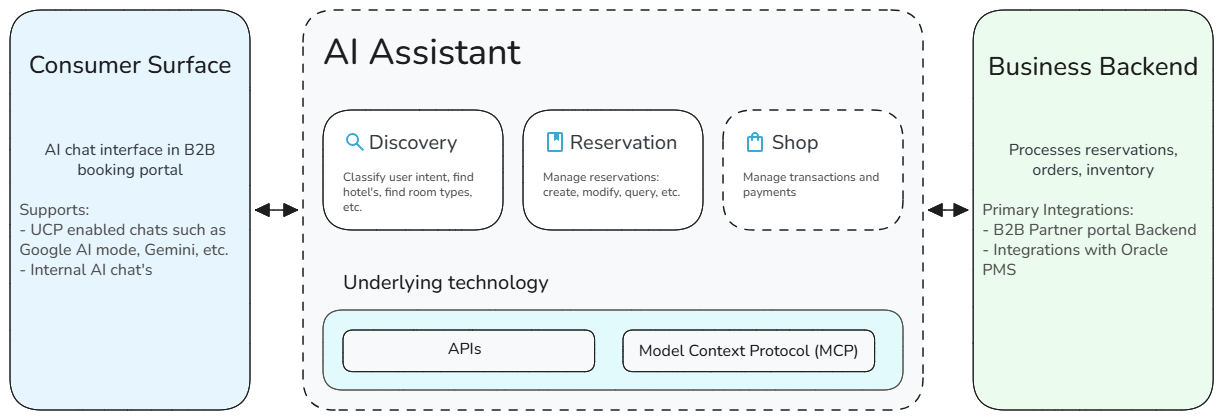
The assistant executes real transactions against the same backend services that power the portal UI. Seven tools sit in a single registered layer with structured schemas and strict execution constraints; the booking flow enforces a fixed sequence and the reservation tool fires exactly once per confirmation, preventing double-bookings at the protocol level.
The tools are exposed through an MCP server. The industry is converging on universal commerce protocols that let autonomous AI agents discover services and execute transactions on behalf of users, and this system is ready for it. When AI travel agents make purchases autonomously, they connect to the same endpoint, discover the same tools, and run the same booking flow, opening significant revenue potential for the hospitality sector.
Live integration with Oracle PMS
The portal connects directly to the Oracle Property Management System, the operational backbone for rooms, rates, and reservations across all properties. Every search result and rate displayed reflects live data; agents book against the source of truth.
The platform uses a contract-driven API model. As the portfolio grows through the expansion pipeline, new properties connect with minimal work, no re-engineering at each growth milestone.
Interface design
The interface is built for the B2B agent workflow, not a consumer booking experience. Data-dense where agents need it; clean navigation where clarity matters.
Agents land on a dashboard showing recent bookings, status indicators, and revenue summaries at a glance. Hotel and room browsing delivers rich content: descriptions, room types, pricing sidebars. The AI assistant sits in a persistent sidebar, accessible from any screen, so agents engage it conversationally while navigating the portal.
Business impact
Margin retention
Every booking through the portal is a booking without an intermediary commission. The directional impact is straightforward and scales with adoption.
Booking velocity
The platform is built for high-frequency B2B operations; booking targets and attainment are tracked in real time at the management level. As adoption scales, performance data flows into dashboards without manual aggregation, giving hotel management a live view of volume against targets at any point in the month.
Operational efficiency
Agents who managed bookings through email threads, phone calls, and spreadsheets now complete booking, modification, and invoice retrieval in a single interface. Lower cost, lower error rate.
Channel stickiness
Agents who integrate the portal into their daily workflow develop dependency on the hotel's tooling rather than a third-party platform. Loyalty follows the tool, and the tool belongs to the hotel.
Future-readiness
The MCP-compatible service layer means the portal is ready for autonomous AI agents entering the travel purchasing space. As the industry shifts toward agent-to-agent commerce, the client's direct channel is already addressable by the next generation of booking systems.
What this means for prospective clients
Zirora Direct is a reference architecture. Zirora adapts it for hotel groups and hospitality operators facing the same distribution challenge.
Oracle PMS integration, role-based access, AI-assisted booking, an MCP-compatible service layer, automated invoicing, management dashboards: the core platform is configurable across different portfolio sizes, PMS vendors, and market contexts. Whether a client manages 5 properties or 500, the need is the same, a direct channel that delivers rate control, booking visibility, stronger agent relationships, and a protocol layer ready for the AI agents that will reshape travel distribution.
Scope a solution for your portfolio